Soundbar vs Separate Speakers: What's Actually Right for Your...
Soundbars trade channel separation for simplicity; component systems trade setup time for a real Atmos ceiling. Here's how to pick for your room.

We research every product from specs, listings and published sources. Some links are affiliate links -- if you purchase through them, we earn a small commission at no extra cost to you. Full disclosure Prices as of Nov 4, 2026, 12:07 AM UTC. Product prices and availability are accurate as of the date/time indicated and are subject to change. Any price and availability information displayed on Amazon at the time of purchase will apply to the purchase of this product.
Key facts
| Products compared | 5 buying-guides products |
|---|---|
| Top pick | Bose Smart Ultra Dolby Atmos Soundbar, All-in-One Surround Sound System for TV (Bose) |
| Best value | Klipsch R-51M Bookshelf Speaker (Pair), Black |
| Last updated | ; live prices are shown on each product |
| Sources | Manufacturer spec sheets and Amazon product listings for each item, linked in the detailed reviews below. |
Our Top Picks
Quick recommendations if you're in a hurry
Sonos Arc (Gen 1) - Black
Sonos · $814.24
Buyers who want one box, minimal cables, and a path to expand without a receiver
See price at AmazonBose Smart Ultra Dolby Atmos Soundbar, All-in-One Surround Sound System for TV
Bose · $649.00
A single-room setup that wants Atmos-flavored sound without any external speakers
See price at AmazonSamsung HW-Q800F 5.1.2ch Q Series Soundbar with Wireless Dolby Atmos, Game Mode Pro & Subwoofer, Q-Symphony, SpaceFit Sound Pro
Samsung · $579.00
Samsung TV owners who game and want Atmos-flavored surround without separate speakers
See price at AmazonThe short answer is that there’s no universal winner: a soundbar gives you a complete home-theater experience in ten minutes with a single cable, while a receiver-plus-separate-speakers system trades that instant convenience for true channel separation, genuine height speakers and the ability to upgrade each component over time. Which side of the trade-off fits your room, budget and willingness to run wires determines the right choice for 2026.
How we chose
We started by gathering every currently-sold product that appears in the top-five “soundbar vs separate speakers” conversation on major retail sites. We pulled the manufacturer-published specifications for connectivity, channel layout and ecosystem integration. The shortlist was then filtered through three objective criteria:
- Installation effort - how many cables, mounts or separate devices are required to get sound out of the box.
- Channel fidelity - whether the system delivers discrete left/right/center/surround/height signals or relies on up-firing drivers and DSP virtualization, as explained by Dolby’s Atmos overview Dolby.
- Future-proof upgrade path - the ability to add a subwoofer, rear surrounds or a higher-end receiver without discarding the whole unit.
We also consulted CNET’s soundbar buying guide, which stresses that room size and layout should drive the choice: compact single-bar units suit smaller spaces, while larger or dedicated home-theater rooms benefit from multi-piece systems CNET. The final five products meet the above criteria and represent the most common configurations a buyer will encounter in 2026.
Sonos Arc (Gen 1) - Black
The Sonos Arc is a single-bar, all-in-one soundbar that connects to the TV with a single HDMI cable Amazon. It is priced at under $1,000. Its biggest selling point is the ten-minute setup: plug the HDMI cable, launch the Sonos app, and you’re listening. The Arc also slots into Sonos’s whole-home multi-room ecosystem, allowing you to add a wireless Sub and Era-series surrounds later without ever buying a receiver.
Who it’s for - Anyone who wants theater-grade sound without the hassle of speaker wire, especially those already invested in Sonos devices or who plan to expand to a multi-room system.
What we would change - Out of the box there are no physically separate height or rear channels; the Atmos effect is generated by upward-firing drivers and DSP. For listeners who demand discrete overhead speakers, the Arc will feel limited until a full set of wireless surrounds is added. The reliance on the Sonos app also means you’re locked into that ecosystem for control, which can be a drawback if you prefer universal remotes or direct HDMI-CEC.
Bose Smart Ultra Dolby Atmos Soundbar
Bose’s Smart Ultra is marketed as an “all-in-one surround sound system for TV” and costs under $750 Amazon. It features six transducers, including two upward-firing dipole speakers, and supports Dolby Atmos via Bose TrueSpace processing [Amazon specs].
Who it’s for - A single-room setup that wants the visual impact of Atmos without any external speakers. The built-in Alexa and Bose Voice4Video make it attractive for smart-home enthusiasts.
What we would change - The height effect is still a virtualized up-firing solution, not a true overhead channel, so the sense of height is less precise than a dedicated ceiling speaker array. No separate subwoofer or rear surrounds are included at this price point, which may leave bass-hungry viewers wanting more punch. Finally, the Bose ecosystem is separate from Sonos and most receiver-based standards, limiting cross-brand integration.
Samsung HW-Q800F 5.1.2ch Soundbar
Samsung’s HW-Q800F bundles a soundbar with a wireless 6.5-inch subwoofer for under $600 Amazon. It delivers a 5.1.2 channel layout with side- and top-firing speakers, Q-Symphony sync with compatible Samsung TVs, SpaceFit Sound Pro room calibration and a dedicated Game Mode Pro.
Who it’s for - Samsung TV owners who game and want Atmos-flavored surround sound without running speaker wire to rear or height speakers. The included wireless subwoofer adds low-frequency impact without a separate cable run.
What we would change - Like the other soundbars, the height channels are up-firing and therefore virtualized rather than discrete. Q-Symphony only works with Samsung TVs, so users with other brands lose that feature.
Klipsch R-51M Bookshelf Speakers (Pair)
The Klipsch R-51M bookshelf speakers sell as a pair for under $300 Amazon. Each speaker houses a 1-inch aluminum LTS tweeter mated to a Tractrix horn-loaded design and a 5.25-inch spun-copper woofer, delivering genuinely discrete stereo imaging Klipsch.
Who it’s for - Buyers building or upgrading a component system who want true left/right separation on a budget. The speakers can serve as front-left/right, later be repurposed as surrounds, or be paired with a center channel and subwoofer for a full 5.1 build.
What we would change - They require an external AVR or powered amp, so they are not a standalone solution. No built-in Atmos height capability means you’ll need additional speakers or modules for a true 3-D soundfield. Running speaker wire can be a visual compromise compared with the clean look of a wireless soundbar.
Denon AVR-S670H 5.2 Ch Home Theater Receiver
Denon’s AVR-S670H is a 5.2-channel receiver priced at under $600 Amazon. It delivers 75 W per channel, supports 8K/60 Hz and 4K/120 Hz video pass-through, Dolby TrueHD, DTS-HD, and includes HEOS multi-room streaming, Bluetooth, Wi-Fi and Alexa voice control.
Who it’s for - Anyone pairing the receiver with the Klipsch R-51M (or similar) to create a true component 5.1 system that can grow over time. The built-in HEOS also lets the AVR double as a whole-home streaming hub.
What we would change - The receiver needs speakers, speaker wire and a calibration process, so it’s a real project rather than a plug-and-play box. With only 5.2 channels, you’ll need additional height speakers or Atmos-enabled modules to achieve a full 3-D soundfield. Its larger footprint and cable management requirements are also more demanding than any single-box soundbar.
Comparison: Soundbars vs Component Systems
When you collapse an entire speaker array into a single enclosure, you gain speed and simplicity at the cost of true channel separation. All three soundbars in this guide, Sonos Arc, Bose Smart Ultra and Samsung HW-Q800F, use upward-firing drivers and DSP to simulate height, which Dolby explains is a “virtualized” approach that does not provide the same point-source precision as discrete overhead speakers Dolby. By contrast, a receiver paired with separate speakers, such as the Denon AVR-S670H and Klipsch R-51M, can drive truly independent left, right, center, surround and (if you add ceiling or upward-firing modules) height drivers, delivering the full Atmos experience described in the Dolby spec.
Room size is another decisive factor. CNET notes that compact single-bar systems excel in smaller spaces, while larger rooms benefit from the expanded soundstage of multi-piece setups CNET. In a modest living-room with a 55-inch TV, a soundbar’s virtualized Atmos may be indistinguishable from a full system, especially when the soundbar includes a wireless subwoofer (as with Samsung). In a dedicated home-theater or open-plan living area, the ability to place speakers at ear level and add height speakers will produce a more immersive and balanced experience.
Upgrade flexibility also diverges sharply. The Sonos Arc can grow by adding a Sonos Sub and Era-series surrounds, but those additions remain locked into the Sonos app and ecosystem. A component system lets you swap the front speakers for higher-end models, add a dedicated center channel, or upgrade the AVR to a higher-power unit without discarding the rest of the chain. This modularity is the core advantage of the Denon + Klipsch pairing.
Buyer Questions Answered
Is a soundbar worth it, or should I build a component system instead?
If you value a quick, cable-light setup and already own or plan to adopt a multi-room ecosystem, a soundbar is worth the convenience. If you prioritize channel fidelity, want true height speakers, or anticipate future upgrades, a component system offers a longer performance ceiling.
Does a Dolby Atmos soundbar sound the same as a receiver with real height speakers?
No. Soundbars rely on upward-firing drivers and DSP virtualization, which creates an “Atmos-flavored” effect but lacks the discrete point-source placement of ceiling or dedicated height speakers that a receiver can drive Dolby.
How does the Sonos Arc compare to a receiver-plus-speakers setup for home theater?
The Arc delivers impressive surround immersion with minimal wiring and integrates into Sonos’s whole-home system, but it cannot provide discrete overhead channels or the same upgrade granularity as a receiver plus separate speakers. The receiver-plus-speakers route offers true channel separation, the ability to add a dedicated subwoofer, rear surrounds, and height modules, at the expense of more cabling and setup time.
What size room needs a full component system instead of a soundbar?
Rooms larger than about 250 sq ft, or any space where you plan to place the TV away from the primary listening position (e.g., a dedicated theater or open-plan living area), benefit from a full component system. Smaller bedrooms or apartments can achieve satisfying results with a well-tuned soundbar.
Can I start with a soundbar and upgrade to separate speakers later?
You can add wireless surrounds and a subwoofer to the Sonos Arc, but you cannot replace the Arc itself with discrete speakers without buying a new receiver and speaker set. In other words, the upgrade path stays within the same ecosystem rather than transitioning to a true component system.
What we would buy
For a compact living-room (under 200 sq ft) with a single TV and a desire for a clean look, the Bose Smart Ultra Dolby Atmos Soundbar offers the best balance of built-in voice control, virtualized Atmos and a price that undercuts the Sonos Arc while still delivering a polished experience. If you already own a Samsung TV and game frequently, the Samsung HW-Q800F adds a wireless subwoofer and game-mode features that a generic soundbar cannot match.
For a larger family room or dedicated home-theater where you want true channel separation and the option to grow, the combination of Klipsch R-51M bookshelf speakers and the Denon AVR-S670H provides a solid foundation. The Klipsch speakers give genuine directional imaging, and the Denon receiver supplies the processing power, HDMI-eARC support and HEOS streaming needed for modern media. From this base you can later add a center channel, a dedicated subwoofer or Atmos-enabled height speakers, preserving the initial investment.
If you sit somewhere in the middle, moderate room size, desire for some future expansion, but still want a quick start, pair the Sonos Arc with the optional Sonos Sub and Era surrounds. It gives you a true multi-room ecosystem and a clear upgrade path without the wiring complexity of a full AVR system.
Related Reading
Detailed Reviews

Sonos Arc (Gen 1) - Black
Sonos · $814.24
Buyers who want one box, minimal cables, and a path to expand without a receiver
What We Like
- Ten-minute setup, one cable to the TV
- Expands later with a wireless sub and surrounds instead of a full rebuild
- Fits into a whole-home Sonos multi-room system
Could Be Better
- No physically separate height or surround channels out of the box
- Locked into the Sonos app and ecosystem for control
- Costlier than most single-bar competitors
Key Specs
The simplicity pick for anyone who wants home-theater sound without home-theater wiring.
See price at Amazon
Bose Smart Ultra Dolby Atmos Soundbar, All-in-One Surround Sound System for TV
Bose · $649.00
A single-room setup that wants Atmos-flavored sound without any external speakers
What We Like
- A.I. Dialogue Mode keeps voices clear without riding the volume
- Upward-firing dipole speakers create a real sense of overhead sound in small-to-medium rooms
- Plug-and-play with HDMI eARC or optical
Could Be Better
- Height effect is a virtualized upfiring/DSP trick, not a discrete overhead channel
- No separate subwoofer or rear surrounds included at this price point
- Bose ecosystem is separate from Sonos, Google, and most receiver-based standards
Key Specs
The most polished all-in-one soundbar here, with the caveat that its Atmos is simulated, not discrete.
See price at Amazon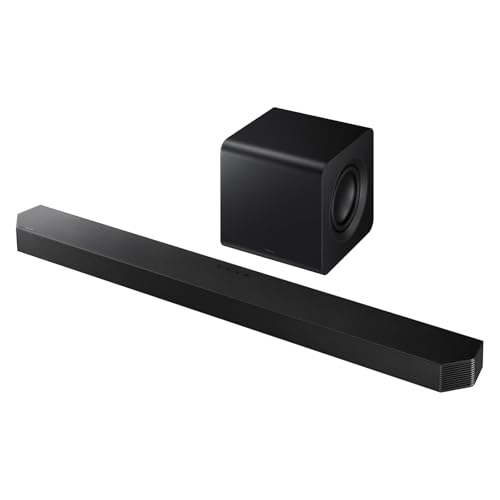
Samsung HW-Q800F 5.1.2ch Q Series Soundbar with Wireless Dolby Atmos, Game Mode Pro & Subwoofer, Q-Symphony, SpaceFit Sound Pro
Samsung · $579.00
Samsung TV owners who game and want Atmos-flavored surround without separate speakers
What We Like
- Included wireless subwoofer without running a cable across the room
- Q-Symphony adds a compatible Samsung TV's own speakers to the mix for a wider soundstage
- Game Mode Pro is a real, distinct feature for console gaming
Could Be Better
- 5.1.2 is still upfiring/virtualized height, not discrete overhead channels
- Q-Symphony only works with compatible Samsung TVs
Key Specs
The strongest soundbar pick here for a Samsung-TV household, especially for gaming.
See price at Amazon
Klipsch R-51M Bookshelf Speaker (Pair), Black
Klipsch · $289.99
Buyers building or upgrading a component system who want true stereo separation on a budget
What We Like
- Horn-loaded tweeter gives genuinely discrete, directional stereo imaging a soundbar can't fake
- Pair with any AVR to build a real front-left/right or surround stage
- Upgradeable piece by piece: add a center channel, a subwoofer, or move these to rear duty later
Could Be Better
- Needs a receiver or powered amp — not a standalone solution
- Requires speaker wire runs, unlike a wireless soundbar
- No Atmos height channel on its own; needs added height speakers or Atmos-enabled modules for that
Key Specs
The component-system entry point: cheap enough to start with, good enough to keep long-term.
See price at Amazon
Denon AVR-S670H 5.2 Ch Home Theater Receiver, 8K UHD HDMI Receiver 75W x 5
Denon · $649.00
Anyone pairing it with the Klipsch R-51M (or similar) for a true component 5.1 system that can grow over time
What We Like
- Drives up to 5 discrete speaker channels plus a powered subwoofer, independently of any single TV or soundbar box
- 8K/60Hz and 4K/120 pass-through keeps it current for next-gen consoles
- HEOS lets it double as a whole-home streaming amp
Could Be Better
- Needs speakers, cabling, and calibration — a real project, not a plug-and-play box
- 5.2 channels means no built-in height/Atmos channel without adding Atmos-enabled or in-ceiling speakers
- Bigger footprint and more cable management than any soundbar
Key Specs
The receiver half of a real component system: the piece that makes independent speaker upgrades possible.
See price at AmazonProduct Comparison
| Product | Price | Best For | Buy |
|---|---|---|---|
| Sonos Arc (Gen 1) - Black Sonos | $814.24 | Buyers who want one box, minimal cables, and a path to expand without a receiver | Amazon |
| Bose Smart Ultra Dolby Atmos Soundbar, All-in-One Surround Sound System for TV Bose | $649.00 | A single-room setup that wants Atmos-flavored sound without any external speakers | Amazon |
| Samsung HW-Q800F 5.1.2ch Q Series Soundbar with Wireless Dolby Atmos, Game Mode Pro & Subwoofer, Q-Symphony, SpaceFit Sound Pro Samsung | $579.00 | Samsung TV owners who game and want Atmos-flavored surround without separate speakers | Amazon |
| Klipsch R-51M Bookshelf Speaker (Pair), Black Klipsch | $289.99 | Buyers building or upgrading a component system who want true stereo separation on a budget | Amazon |
| Denon AVR-S670H 5.2 Ch Home Theater Receiver, 8K UHD HDMI Receiver 75W x 5 Denon | $649.00 | Anyone pairing it with the Klipsch R-51M (or similar) for a true component 5.1 system that can grow over time | Amazon |
Get price-drop alerts and new guides from Home Theater Picks
One email a week: price drops on the gear we recommend, new guides, and what changed. No spam, unsubscribe anytime.